Connecting the Dots: How Fabric IQ Helps Life Sciences Organizations Turn Data into Shared Understanding

Chandrasekhar
Only 22% of life sciences leaders say they’ve successfully scaled AI, and just 9% report significant returns, according to Deloitte’s 2026 Life Sciences Outlook. Yet life sciences is rich in data, from early assays and trial outcomes to batch records, payer contracts, and patient support calls.
The gap often comes down to definitions.
Ask a clinical operations lead, a plant manager, and a brand director what a “site” is, and you’ll get three different answers. In clinical operations, it’s where investigators enroll patients. In manufacturing, it’s a plant. In commercial, it’s a site of care. All three are correct, but an AI agent told to “flag at-risk sites” cannot know which definition applies.
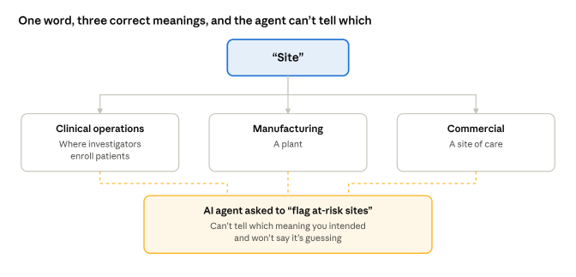
Illustration · how three functions define “site”
Why consolidation alone didn’t fix it
Consolidation brought fragmented data into governed platforms and reduced pipeline sprawl. But putting ERP, LIMS, CTMS, and CRM data together doesn’t reconcile their vocabularies. Teams can still disagree on core definitions even when every table sits in the same place.
ZS’s 2026 CDIO research found that 68% of surveyed pharma and biotech technology executives cited early neglect of data quality and governance as the main reason AI initiatives fail. Only 40% of pilots that met an initial value bar reached scaled deployment. In a pilot, a small team can agree on definitions and curate the data. At scale, those unwritten assumptions become a problem.
How Fabric IQ adds business context
Microsoft Fabric IQ adds a layer of business meaning to existing data so people and AI agents can work with molecules, trials, batches, payers, and patients rather than just tables and columns. It is part of Microsoft’s broader IQ family, alongside Work IQ, Foundry IQ, and Web IQ.
The building blocks of Fabric IQ
Fabric IQ is a set of components designed to work together, each with a distinct job.
- OneLake: The data foundation. It brings ERP, LIMS, CTMS, and CRM data into one governed view without unnecessary copying.
- Ontology: Shared business meaning. It defines entities like Compound, Study, Site, and Batch, how they relate, and the rules behind them, such as what counts as an at-risk enrollment site.
- Semantic models: Consistent measures. Fabric IQ reuses existing Power BI measures like enrollment rate and batch yield, so business logic already in use carries over.
- Graph: Connected relationships. Teams can trace which batches used a suspect raw material lot, or which trials share investigators with a site under audit.
- Data agents: Answers in business language. They respond to plain-language questions through Microsoft 365, Copilot Studio, Foundry, or custom apps.
- Operations agents: Monitoring with oversight. They watch live data against defined rules and recommend actions for human approval in Microsoft Teams.
- Planning: Connected forecasts. Budgets, forecasts, and scenarios sit alongside governed data, so teams can compare plans with actual results.
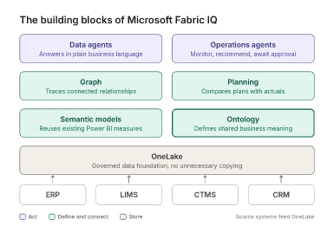
Together, OneLake supplies the data, semantic models and ontology define its meaning, graph connects relationships, planning links decisions to forecasts, and agents surface answers and actions.
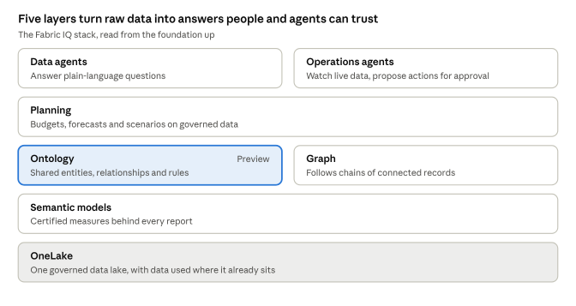
Fabric IQ components · ontology in preview as of August 2026
Each layer depends on the one beneath it, and the ontology is what gives everything above it a shared vocabulary.
Fabric IQ across the Life Sciences Value Chain
The same foundation plays out differently in each function. Here’s how it looks in Commercial, R&D, and Manufacturing and Quality.
Fabric IQ in Commercial: A connected view of access and demand
Commercial teams combine claims, specialty pharmacy, hub services, payer, CRM, and contract data, often with inconsistent definitions and reporting schedules.
IQVIA data shows that 70% of commercial attempts to fill a new branded medicine were initially denied coverage in 2025, up from 57% in 2021. When the data behind those denials sits in separate systems, teams take longer to see where access is breaking down.
With Fabric IQ, commercial teams can connect external and internal data and define relationships among payers, plans, prescribers, pharmacies, and patient journey stages. A data agent could then answer “How did last quarter’s step-edit changes affect new patient starts in our lead indication?” using approved definitions.
Graph can reveal relationships among plans, pharmacy benefit managers, and referral pathways. Operations agents can monitor increases in prior authorization denials or abandoned prescriptions and alert reimbursement teams.
Fabric IQ in R&D: Connecting science, sites, and studies
R&D data spans discovery, assays, preclinical research, trial operations, safety, and regulatory submissions across systems and external partners.
An R&D ontology can connect targets, compounds, studies, protocols, sites, and investigators. Graph makes it easier to trace relationships from discovery to outcomes and spot sites or vendors shared across trials.
A widely cited Tufts CSDD study across more than 150 studies and nearly 16,000 sites found that 11% of sites enroll no patients and 37% under-enroll. Data agents could identify sites behind enrollment targets and common screening failures. Operations agents could monitor enrollment, deviations, and query backlogs so study managers can act earlier.
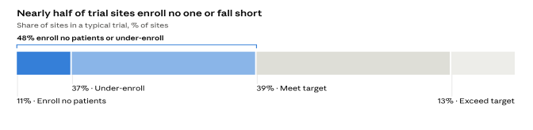
Tufts CSDD · 150+ studies, nearly 16,000 sites
Spotting those underperforming sites early is where an operations agent earns its place on a study team.
Fabric IQ in Manufacturing and Quality: Traceability, early warning, and continuous improvement
Batch records, raw material lots, equipment data, deviations, CAPAs, and complaints often sit in separate systems. That slows root cause investigations and makes traceability harder.
A manufacturing ontology connects materials, lots, batches, equipment, deviations, and shipments. The graph can trace which batches used a suspect raw material lot and where the finished products went.
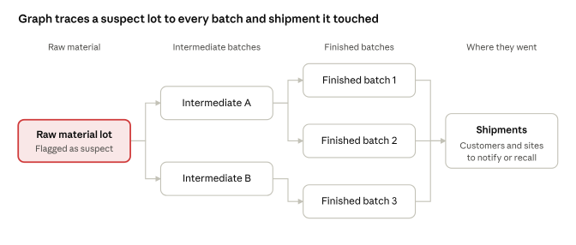
Illustration · batch genealogy for one suspect lot
Operations agents can watch process drift and deviation trends, then recommend steps for production and quality teams to approve. Data agents can answer questions about rising deviations and overdue CAPAs, while planning connects demand with capacity and supply.
In GxP settings, organizations remain responsible for validation, data integrity, and regulatory compliance. Fabric IQ’s governance and permission controls support that work but do not replace it.
Why Fabric IQ matters now
Fabric IQ’s value goes beyond connecting data. It helps Commercial, R&D, Manufacturing, and Quality teams make decisions based on a shared understanding of the business. A batch issue can inform supply and commercial planning, while changes in trial timelines can feed into manufacturing forecasts. AI agents can use these connected relationships to provide more relevant answers and support better decisions.
This shared context also helps organizations move AI beyond isolated pilots by making business definitions reusable across teams and agents. The timing matters. As Microsoft Fabric IQ continues to mature, life sciences organizations can strengthen their data foundations, establish shared business definitions, and prepare to scale AI across functions.
How WinWire can help
Most life sciences teams don’t need another platform pitch. They need a partner who understands why “site” means three different things inside one company, and who can turn that into a model their agents will actually use.
WinWire is a Microsoft Solutions Partner for Data & AI, an Azure Expert MSP, and a member of Microsoft’s Agentic Partner Alliance, with a long track record in healthcare and life sciences. Microsoft named WinWire a Partner of the Year in the Modernizing Applications category, recognizing its work helping a leading drug discovery organization accelerate drug development on the Azure AI platform.
WinWire brings that same domain depth to Fabric IQ, starting with the business definitions before any modeling begins. A typical Fabric IQ engagement covers four areas:
- Use-case prioritization: WinWire’s Value Case Prioritization engine ranks candidate agentic AI use cases and tracks them once they’re live, so leaders can see which decisions are worth connecting first.
- Fabric readiness: Four-week assessments for teams moving from SQL Server or Oracle data warehouses, plus a Fabric adoption workshop to get the OneLake foundation right before any modeling starts.
- Ontology design with your domain experts: WinWire works alongside clinical operations, quality, and commercial leads to agree on definitions first, then models them, reusing Power BI semantic models already in production wherever possible.
- Agents built for regulated work: Data and operations agents ship with evaluation sets, human approvals in Microsoft Teams, and Microsoft Purview governance, so every recommendation is auditable.
The work runs on WinWire’s 3i framework (Imagine, Ignite, Impact), which is designed to move pilots into production with use cases tied to measurable ROI.
A good first project is deliberately narrow, such as an enrollment monitoring agent for a pivotal trial or a batch genealogy explorer for one key product.
If you’ve got a use case like that in mind, or you’re still working out where Fabric IQ fits, talk to us. We’d be glad to help you figure out where to start.