Azure HorizonDB: Less Plumbing for Enterprise AI Agents

Vineet
I’ve been waiting for this one. Microsoft announced at Ignite on November 17, 2026, that Azure HorizonDB is now generally available, and Fabric HorizonDB has moved into public preview alongside it. In my view, it’s one of the most practical announcements of the week because it could take a lot off our plate when we build AI agents for enterprise customers.
The plumbing problem nobody puts on the slide
When we build agents, the agent logic is rarely where most of the hours go. A big part of the effort goes into plumbing. An enterprise agent build can involve four separate systems: a transactional database, a vector store, an analytics warehouse, and a memory cache for session context. Depending on the task, the agent may need to pull data from several of them.
Then come the sync jobs that keep data consistent across these systems. I’d argue this is the most underrated cost in agent projects. Nobody demos it, but it’s where things break. When one sync job lags, the agent works from stale context, and usually nobody notices until a user encounters an incorrect or outdated response. For our healthcare and life sciences customers, that kind of drift is more than an inconvenience.
What Azure HorizonDB changes
Azure HorizonDB brings transactional processing, vector search, and AI capabilities closer together within a PostgreSQL database. Instead of maintaining separate systems for every data access requirement, an agent can access transactional records and vector embeddings through the same database. In practice, that could mean fewer separate data stores for the agent, with operational data and embeddings in HorizonDB and analytics handled in Fabric. HorizonDB supports DiskANN vector indexing, with advanced filtering currently in preview. It also integrates with Microsoft Foundry models.
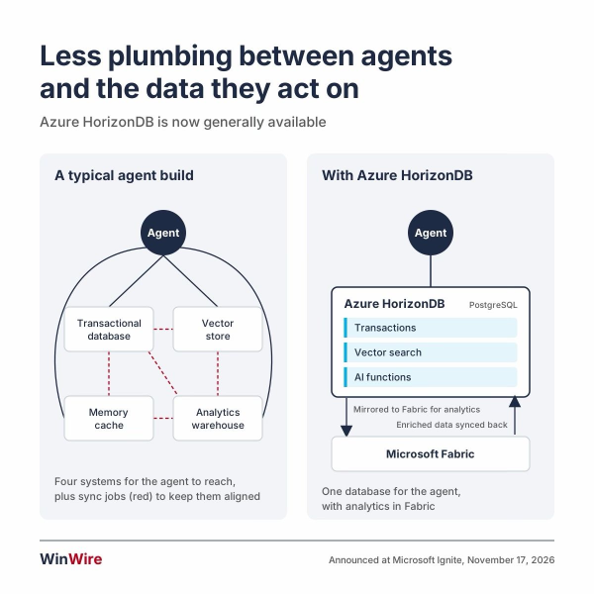
The Fabric integration is the part I’m most excited about. Azure HorizonDB supports zero-ETL mirroring into Microsoft Fabric OneLake, so operational data is ready for analytics without custom pipelines. Data can go out for analytics and come back enriched for the agent to use.
That is a LOT less plumbing, and in my experience, less plumbing means fewer things to break in production.
It’s also PostgreSQL, and I think that matters more than people expect. Teams can continue using familiar PostgreSQL tools and supported extensions, and a database that asks people to relearn everything tends to stall in the pilot phase.
How we’ll design agent architectures from here
I believe this will change how we design agent architectures on Azure going forward. For new builds, we’ll start by asking whether the agent’s operational data, embeddings, and relevant context can sit together in HorizonDB, adding separate stores where the workload demands them. A year ago, I’d have started the other way around.
Not every workload needs to move to HorizonDB. Customers with large estates on other databases will need time to migrate, and Fabric HorizonDB is still in preview, so we’ll treat it that way. But for a new agent on Azure, HorizonDB is worth evaluating as a simpler starting point, and simpler architectures are easier to govern and keep running once the demo is over.
If you’re building enterprise AI agents on Azure, let’s talk about where HorizonDB could simplify your architecture.