Building an Enterprise Agentic AI Testing Assistant – A Practical Implementation Guide

Vincent

INTRODUCTION
Enterprise software testing is in the process of shifting from its fundamentals by incorporating Generative AI, Retrieval Augmented Generation (RAG), and intelligent knowledge systems. Traditional QA approaches of manual test design, automation, and defect management are no longer enough in today’s development pipeline, which requires speed, accuracy, and continuing validation.
This blog provides an enterprise blueprint for creating a Gen AI Testing Assistant to give control of QA Knowledge and automate test intelligence. It also showcases how to use AI across the software lifecycle.
EXECUTIVE SUMMARY
Enterprise QA teams face a structural problem, not a tool issue, where knowledge is kept in small pieces across disconnected systems even though using automation and pipelines. Requirements, documentation, execution data, and production bugs most of the time live in separate platforms that do not share information.
This disconnection results in three critical challenges.
- Test case creation remains heavily manual and needs to be created from scratch for every new feature.
- Historical data is not used to solve similar testing problems.
- Regression cycles are slow because impact analysis is based on human understanding.
This blog provides an idea for an enterprise-grade solution, Gen AI Testing Assistant powered by RAG and vector-based knowledge systems. This system is designed to unite QA knowledge from all disconnected tools, get historical data from older systems, and generate defined test cases and other details using large language models.
This system does not replace QA engineers. But it transforms them into quality intelligence reviewers and system architects. The system will provide faster decision-making, improve coverage, and reduce regression risk.
WHY THIS TRANSFORMATION IS REQUIRED
The software development environment has changed faster than QA methodologies have grown. Development teams now operate on continuous deployment cycles, releasing multiple changes per day. In contrast, QA processes are still working on manual test design cycles, manual testing, and retrospective bug analysis.
This mismatch creates a bottleneck where QA becomes the limiting factor in the software process velocity. While developers benefit from AI tools and assistance in coding tools, QA teams are still required to manually analyze requirements and prepare test cases, and connect defects across multiple systems.
Industry research shows that QA teams spend a lot of time on repetitive thinking tasks rather than actual testing and analysis. Activities such as rewriting similar test cases, reviewing recurring defects, and identifying which areas have regression activities are still performed manually in most organizations.
Generative AI changes this approach. AI systems can now help QA teams by understanding requirements written in natural language, finding relevant information from enterprise data, and generating structured outputs. However, this is useful only when AI is part of a properly managed enterprise setup with the right retrieval, security, and validation processes.
REAL WORLD SCENARIO: HOW QA WORKS TODAY VS WITH AI
Consider an organization user story: a feature that allows users to update profile preferences with validation rules and audit logging.
In traditional QA practices, the engineer will read the requirements manually and understand the acceptance criteria. They must check for similar test cases from past features, identify relevant requirements, and create test scenarios from scratch. The same process is repeated in different teams and different projects. This process most of the time results in duplicate work and inconsistent test coverage.
Next, let’s see the same feature using AI. The same user story is submitted to Gen AI Testing Assistant. The system will automatically get similar user stories from the DB and find related defects. It will also evaluate existing automation coverage in frameworks and extract related API or any other QA artifacts. It uses this information to create structured test cases and scenarios.
Now the QA engineer’s role shifts from creation to verification. Instead of creating test cases manually, they review AI-generated test cases, refine edge conditions, and can finalize test cases for execution. This reduces test case creation cycles from hours to minutes while improving consistency and coverage.
REALITY CHECK: WHAT THIS SYSTEM IS AND IS NOT
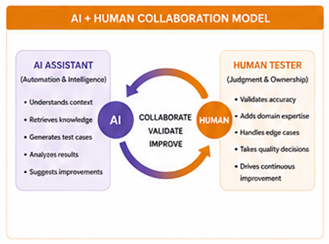
The Gen AI testing assistance functions as an augmentation layer that generates new data from existing data, increases test design creation time, and reduces analysis effort. This helps the QA team work faster.
It does not replace human QA expertise. Instead, it acts as a support tool that helps testers make better decisions and improve productivity.
ENTERPRISE ARCHITECTURE OVERVIEW
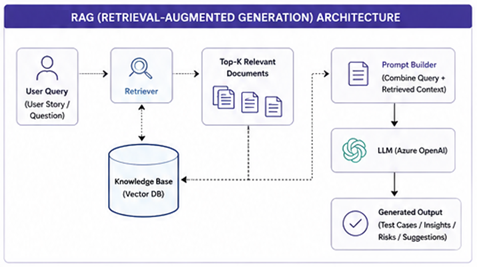
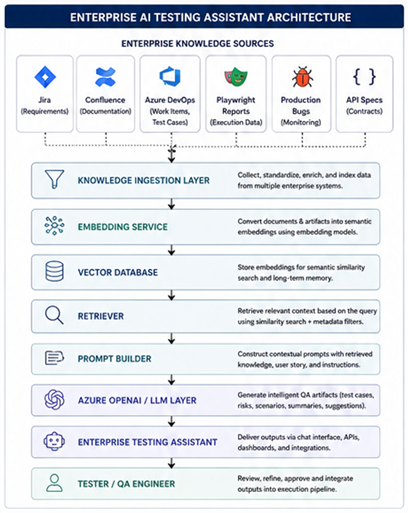
At the core of the solution is a multi-layered enterprise architecture which is designed to convert disconnected QA knowledge into structured data.
It standardizes this data and converts it into numbers so a computer can understand the meaning. This data is saved in a database that acts as the system memory.
When you write a new user story, the system searches its memory for relevant past projects. It sends this helpful history and your new story to an AI model like Azure OpenAI or any other LLM.
The AI then automatically writes your test cases, spots project risks, and suggests what to test. You can access all this directly inside your normal QA workflow.
The output is processed through an enterprise testing assistant interface that integrates directly into QA workflows and approval pipelines.
DETAILED COMPONENT DESIGN
- Knowledge Ingestion Layer
The knowledge ingestion layer collects QA data from tools like Jira, Confluence, and Playwright.
Instead of just copying the files, it cleans up the data and tags it with details like its project name and source. It standardizes different file formats and removes duplicates.
It also manages security rules so only authorized users can see the information. This creates a clean, traceable master list of all company QA data.
- Embedding and Semantic Layer
This layer converts text into numbers (embeddings) to capture the actual meaning of the words.
This helps the system find similar user stories or recurring bugs, even if teams used different words to describe them.
By looking at meaning instead of exact keywords, the system can understand complex QA data across different teams without getting confused by varying terminology.
- Vector Database Layer
The vector database will be the system’s long-term memory.
It stores the data embeddings so the system can quickly search through massive amounts of past work. When you enter a new user story, the database finds similar past test cases and bug patterns.
To keep the results fast and accurate, the system will combine this smart meaning-based search with filters like project names, user stories, and dates.
- Azure OpenAI / LLM Layer
The language model layer acts as the system’s brain.
It takes the historical data from the memory database and uses it to write test cases, find edge cases, and analyze project risks. Because it uses your company’s actual history, the AI’s suggestions are highly specific to your business rather than just generic answers.
The quality of what the AI creates depends entirely on how well the system finds the right past data and structures its instructions.
END-TO-END WORKFLOW
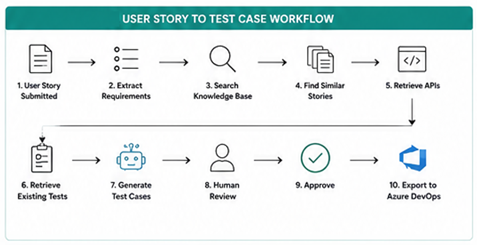
The process will start when you submit a user story.
The system breaks it down into core requirements and searches the database for similar past projects, bugs, and test coverage. It gathers all this history into a single package and sends it to the AI, which instantly writes your new test cases.
Finally, QA engineers review and tweak the test cases before exporting them into tools like Azure DevOps to be run and tracked.
IMPLEMENTATION ROADMAP
We can implement the above idea in an incremental development model. The first phase will focus on enabling basic use story submissions and test case generation. The second phase will introduce integration with automation reports and failure analysis. The third phase will be implementing the RAG-based data fetching layer to provide contextual intelligence. The final phase will introduce interaction capabilities and a dashboard for QA activities.
BUSINESS IMPACT AND ROI
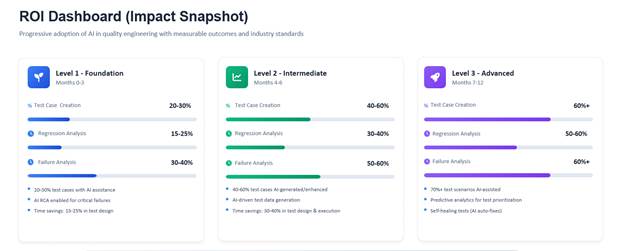
An AI-powered testing assistant can save a lot of time across different QA activities. Test cases that normally take hours can be created in minutes. Regression analysis can be done much faster, and defects can be summarized automatically with the right context.
KEY CHALLENGES AND GOVERNANCE
Using Generative AI in a company comes with risks that must be managed carefully.
The AI can make things up (hallucination risk), be tricked by bad prompts (injection), or accidentally leak private data. Companies also must handle high costs, slow response times, and constant updates to their AI logic.
Because of these issues, humans must always review and approve the AI’s work before it is used in real testing.
FUTURE EVOLUTION OF QA INTELLIGENCE
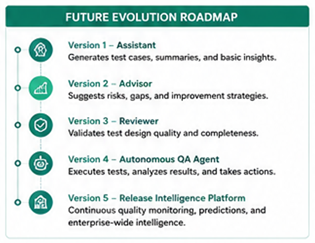
This system can do much more than just create test cases. It can grow step by step. First, it can help testers with their daily work. Then, it can help identify possible risks and review the work done by testers. Over time, it can run tests on its own. In the future, it could even help predict bugs and improve software quality across the organization.
CONCLUSION
This blog explains how an AI testing assistant can help move QA from a manual and scattered process to a smarter and more organized approach.
By combining database search with AI models, teams can find more bugs, improve test coverage, and release software with confidence.
The goal is not to replace QA engineers. Instead, AI can give them better tools and allow them to focus more on important decisions and improving software quality.