ETL Validation Framework: How to Cut Data Reconciliation Time by 67% (Without Writing Python)

Nilanchal
How modern ETL validation framework are redefining data confidence, making pipelines trustworthy and auditable, and quick enough that teams actually bother running them.
Envision the following situation: your team has been working for weeks to move a vital database from SQL Server to Databricks, involving millions of rows and various transformations, yet the date set for going live is still tomorrow. Beneath the adrenaline there is a more subdued and unpleasant question that tends to appear at about 11 p.m.—has every record actually been transferred? Are the null values in the correct positions? Have the primary keys remained unbroken?
Most data teams have experienced this. I’ve attended migration retros in which the honest reply to the question “are we sure this is right?” was a lengthy pause, after which came a collection of SQL scripts, some manual row-count verifications, a few comparisons in Excel, and a prayer. The framework was created with the aim of putting an end to that prayer.
What is an ETL validation framework, and why does it matter?
ETL failures seldom make themselves known; they build up slowly. A row count may gradually differ by a few hundred, or a null value may appear in a place where a business rule had stated it could never appear, or a transformation might alter halfway through a migration, and no one notices until a report turns out to be incorrect weeks later. At that point, trust in the data has already been lost and it takes a lot longer to restore than it did to lose it.
The problem isn’t about transferring the data since modern tools are good at doing that. The real problem consists in continually and on a large scale verifying that the data arriving in the target system is precisely what it should be.

Traditional approaches break down for familiar reasons: validation logic gets duplicated, comparison methods vary by team, test evidence scatters across scripts and email threads, and high-volume reconciliation becomes slow enough that teams stop running it.
How does an ETL validation framework actually work?
The framework is an enterprise ETL validation and data reconciliation solution built on Python, FastAPI, and PyTest. It is not a data movement tool, but the confidence layer that sits above your pipelines and tells you whether they worked.
Connect source and target systems, select tables, run validation in sequence, and walk away with a professional audit-ready report. All from a browser, without writing a single line of Python.
What are the core features of a modern data reconciliation tool?
- Data Integrity: Schema and column types get checked first. Then primary keys, so you know the structure holds before you trust anything sitting on top of it.
- Automated Reconciliation: Row-level comparison across millions of cells with vectorized precision.
- Role-Based Access: Admin, Contributor, and User roles with project-group filtering for governed collaboration.
- Real-time Validation: Execute reconciliation runs on demand or as part of automated pipelines via REST API
- Multi-Source Support: SQL Server, Synapse, Databricks, PostgreSQL, CSV, Parquet, and more.
- Rich Reporting: HTML dashboards and Excel exports that give stakeholders clear, auditable evidence.
How is an ETL validation framework architected?
Frontend Layer
The browser-based interface is a ~14,000-line vanilla HTML/CSS/JS single-page application with no React, no Angular, and no dependencies. It covers login flows, admin dashboards, project configuration, execution, and report access.
Backend Layer
FastAPI handles routing, CORS, session validation, and orchestration to the validation engine. Swagger docs live at /docs, and the REST API allows any CI/CD pipeline, scheduler, or custom integration to trigger validation programmatically.
Validation Engine
The Python engine is organized into reusable modules (extract, transform, load, validate, advanced_validate, report_generator, and automation). Adding a new validation type or connector doesn’t require rewriting the foundation.
Connector Layer
A factory pattern handles connection management across 10+ platforms, with OAuth 2.0 support for Azure and Databricks. File loaders cover CSV, Excel, JSON, Parquet, and cloud storage via AWS S3 and Google Cloud Storage.
How much faster is automated data reconciliation vs. manual checks?
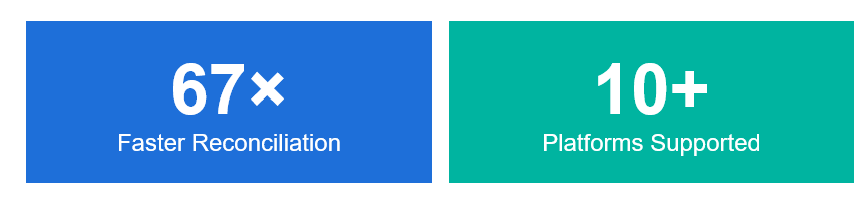
The framework was benchmarked on a real-world dataset: 67 columns × 37,679 rows, totalling over 2.5 million cell operations. Without optimizations, reconciliation took 2–3 minutes, slow enough to discourage frequent runs. Here’s what changed:
| Optimization | Technique | Speed Gain |
| SQLite Batch Inserts | Chunked to_sql() respecting 999-variable limit | 5–10× |
| Fast CSV Reading | pandas C engine, low_memory=False | 2–3× |
| Single-Pass Column Processing | Name cleaning + JSON flatten in one DataFrame pass | 40–50% |
| Vectorized Row Normalization | pandas applymap() replaces Python loops | 10–100× |
| Smart Key Detection | 3-tier: ID columns → high-cardinality → all-columns | Up to 67× |
| Fast CSV Export | pandas to_csv() replaces csv.writer row-by-row | 10–20× |
The headline gain is Smart Key Detection. Comparing on a single business key instead of tuples across all 67 columns improves speed and matching accuracy, up to 67× faster in the best case.
“Performance isn’t a nice-to-have in data validation. If reconciliation takes too long, teams stop running it, and a check nobody runs protects nobody. Speed is what makes confidence possible.”
Can non-engineers use an ETL validation framework?
The framework was designed around a stubborn belief: a validation tool that only engineers can use eventually gets bypassed. I’ve watched this happen firsthand, a check gets skipped once because the one person who knows the SQL is out that week, and after that it’s skipped by default. That’s why usability got treated as a first-class concern here, bringing analysts and testers into the loop, along with the operations staff who usually find out about problems last.
The side-by-side mismatch viewer shows source on the left, target on the right, with differing cells highlighted. Null checks skip tables without NOT NULL constraints, duplicate detection names the columns tested, and every message is written for humans.
For engineers, the REST API and Swagger interface slot the framework into any automation workflow, from nightly regression runs to pre-release gate checks.
How do you validate data in a Microsoft Fabric or Medallion architecture?
As organizations adopt Microsoft Fabric and modern Lakehouse architectures, validation grows more complex. Data flows through Bronze, Silver, and Gold layers, and each transition is a potential source of drift.
Built for this architecture, the framework validates Bronze-to-Silver transformations, Silver-to-Gold aggregations, and cross-layer reconciliation, addressing a gap most Fabric implementations ignore until something breaks.
What are the top use cases for ETL validation tools?
- Data Migration Validation: Moving data between platforms? The framework generates repeatable, auditable evidence that migrated data passed structural checks, count checks, and a full pass at the row level, which makes migration testing something you can defend, not just something you hope held up.
- Daily ETL Regression: Pipelines change. Source systems evolve. Use the framework as a regression harness to validate nightly ETL outputs against defined acceptance criteria, before stakeholders notice the drift.
- Flat File to Database Reconciliation: Finance and partner integrations still run on file transfers. CSV and Excel feeds get validated against downstream database tables with full mismatch reporting, and no bespoke scripts required.
- Shared Validation Services: Role and group controls let a centralized validation function serve multiple project teams without overexposure, making it ideal for shared platform teams and delivery centers.
How secure is an enterprise ETL validation framework?
The framework ships with practical governance built in:
- 8-hour session tokens, auto-invalidated on logout
- SHA-256 password hashing with enforced complexity rules
- Admin, Contributor, and User roles with distinct capability boundaries
- Dynamic project groups that auto-assign when Contributors create projects
- Centralized admin dashboard for role assignment and user activation
No separate identity platform or complex configuration required.
Conclusion: Trust Is Becoming the New Data Currency
Enterprise data estates are becoming more distributed and more dependent on the cloud, extending across a greater number of platforms than any single team is willing to admit. At the same time, a great deal of the validation processes remains where they first began—they are based on a script that someone wrote a few years ago and which still runs only because that person is still there.
A modern ETL validation framework converts manual checks into controlled workflows and separate logic into shared automation. Individual pieces of evidence become something you can actually give to an auditor without feeling uneasy.
The most reliable data platforms won’t be owned by the teams that have the most advanced pipelines; instead, they’ll be owned by those who can clearly and consistently demonstrate that their pipelines function properly.
This is not just another ETL utility. It is the confidence layer your data platform has been missing.