Your Application Management Services (AMS) Provider Is Meeting Its SLAs. So Why Aren’t Your Problems Going Away?

Ashok

Traditional application support keeps systems running. The real issue, though, is whether or not it ever improves them.
The monthly service review looks good. In fact, it looks better than good. SLA compliance is above target, tickets are closing quickly, availability matches the contract.
During the meeting, a business lead mentions an application that keeps misbehaving. You know the one: it failed in March, was fixed, and then failed again in May.
So, who is right, the dashboard or the person speaking?
That is the whole problem: the report looks healthy, but the same issues keep returning. They are closed, reopened, and closed again, each time quickly and neatly. This is what traditional support is built to do. It absorbs the work, month after month, without ever reducing it. So, you pay the same cost for the same ceiling, year after year. For years, we’ve judged application management on the wrong things, mostly how fast tickets closed and how clean the compliance records looked. That isn’t unreasonable. It just never explained why the system still feels broken when every figure shows green.
What the green dashboard leaves out
The metrics share one flaw. They show how efficiently work gets handled, not whether there’s less of it than last quarter. If an application throws the same incident 50 times a month, your provider catches all 50 incidents, resolves them within the SLA window, and closes the tickets early. Yet it doesn’t show the 50 occurrences, or the question behind them: why did one incident happen 50 separate times? Nobody has been paid to ask.
Most contracts reward activity: tickets closed, incidents resolved, mean time to resolution, availability. So, you end up cleaning the same floor month after month and calling it performance.
The work that keeps coming back
In most mature support operations, the real issue is not the volume of work but how much of it keeps returning.
A batch job fails every Tuesday night and has to be restarted. When data volume spikes, the integration drops records, and a reconciliation ticket gets raised. A performance alert fires so often that the team already knows what it means and clears it almost out of habit.
By itself, none of this seems serious. The team moves fast, meets the SLAs, and closes the tickets. Which is exactly why the pattern goes unnoticed.
Over time, support teams get very good at handling recurring problems. They know the workaround, who owns it, and the fastest route to a fix. What they usually don’t have is the time or the incentive to kill the root cause. For leaders, that distinction matters. Responding faster to the same recurring problem doesn’t mean the organization is healthier.
A different kind of Application Management Services (AMS)
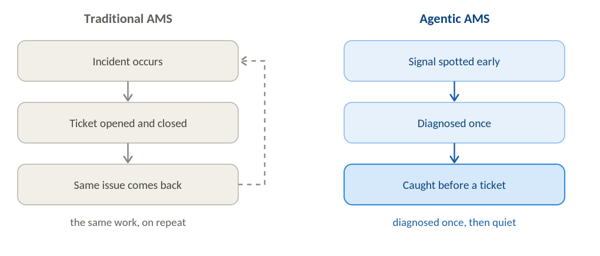
Agentic Application Management Services isn’t conventional AMS with an AI layer on top. Its aim isn’t to handle tickets faster, but to cut the number of tickets that need a human at all.
Agents watch how applications behave and catch signals a person staring at dashboards would miss. When a known failure pattern shows up, they investigate it instead of waiting for a user to report it, then either suggest a fix or apply one that’s already been approved. The batch job that failed every Tuesday gets diagnosed once. After that, the pattern is caught before it becomes a ticket.
Interestingly, none of this removes the need for people. If anything, oversight, permissions, and escalation matter more now because software is being allowed to operate within production systems. The change is in where people spend their time. Less of it goes to clearing the same queue, and more to the work that actually needs a human.
Why this is harder than it looks
The harder problem is commercial, not technical.
Look at how most AMS deals are priced: ticket volumes, hours, and people. That gives the provider little incentive to remove the work altogether, because the work itself generates revenue. No one’s gaming the system here; the contract simply rewards the wrong outcome.
And to be honest, this isn’t only a pricing problem; it’s a structural one. Gartner’s Jason Battye puts it bluntly: traditional IT structures built for control and stability are being outpaced by the demands of agility, resilience, and business alignment. A volume-based AMS contract is one such structure. It was built to keep things steady, not to make them better, and steady is no longer the same as good.
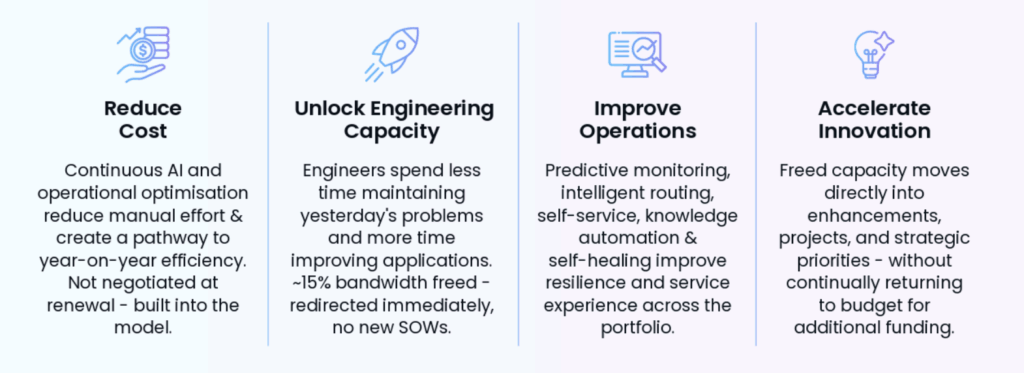
Agentic AMS only works when the math changes. The provider should benefit whenever your systems become more reliable, and the workload decreases, not when the queue remains full. When this is done properly, the money you save shouldn’t quietly increase someone’s margin; it should go back into your backlog and fund the enhancements that always seem to miss the funding process. That is the principle behind WinWire’s Agentic AMS: engagement should become cheaper as it improves.
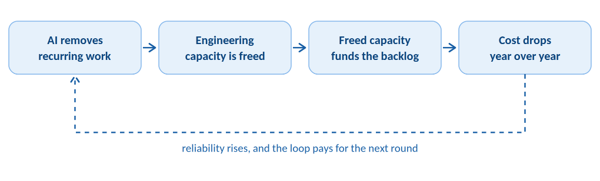
The self-funding loop: efficiency pays for the next round of improvement.
What it looked like in one engagement
A global enterprise came to us with more than 120 applications running in a GxP-regulated environment. The ask was specific. They wanted real productivity gains from AI across that portfolio, but nothing could come at the cost of validation, data integrity, or compliance. Every change had to survive regulatory scrutiny. And they had stopped expecting a managed services partner to deliver anything beyond steady-state support.
The results before we arrived were the familiar kind. Compliance held. But costs stayed flat or crept up, the backlog kept growing, and the operational workload never came down. They were paying a large integrator bench to keep the lights on, and that was about all they were getting.
We came in as the sole provider, taking over from several large integrators. Instead of running application support as one thing and AI as a separate initiative that never quite clears the funding line, we embedded AI, data modernization, and intelligent automation straight into the AMS operating model. The same engagement that kept enterprise applications running also covered pharmacovigilance intake, regulatory reporting, and governed data operations. No side project waiting its turn.
Over three years, the work that kept coming back started to shrink. Pharmacovigilance intake got about 40 percent faster, worth roughly $1.5 million in savings. Regulatory reporting sped up by about 50 percent. On the applications moved to Azure, total cost of ownership dropped by around 80 percent. And 73,800 working hours went back to the business, which added up to more than $3.5 million in return on the engagement.
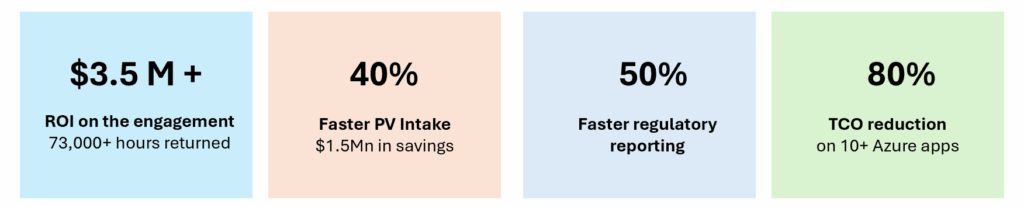
Three year outcomes for a leading healthcare organization
WinWire Agentic Application Management Services (AMS)
WinWire Agentic AMS turns support from a cost center into a catalyst for business value.
Change what you measure
If this is true, the monthly AMS review is asking the wrong questions.
The reports usually answer one question well: how quickly did we deal with the issue? The better question is: why did the problem happen, and what are we doing to stop it from happening again? Instead of resolution speed, look at whether recurring incidents are dropping, how much manual work has come off the team, and how many problems get caught before a user files a ticket. These are outcome measures. The earlier ones measure activity.
Before carrying out your next review, ask your current provider four questions:
- How many recurring tickets will you eliminate permanently this year?
- By how much will my cost be reduced?
- How much operational work will you take off my team?
- And how much engineering capacity will you make available for my innovation roadmap?
If the only responses you receive are a series of SLAs and references to closed tickets, then you’re measuring the wrong things. The next generation of AMS shouldn’t be judged by how efficiently it manages an endless queue. It should be judged by how much of that queue it eliminates. Most teams cannot answer those questions with confidence because the monthly review was never designed to answer them.
That’s where the Innovation Capacity Assessment comes in. We look at the applications you run, the work your teams perform, and the operational tasks pulling engineers away from the roadmap. Then we model the next three years using your own application and ticket history, showing how much cost and engineering capacity could be released. Sometimes the results confirm that the operation is as efficient as the dashboard says.
More often than not, once you move beyond SLA compliance, a different picture emerges. A large share of engineering time is tied up in routine work, while some of the budget needed for the roadmap is already allocated to a managed-services contract that renews every year.
If that sounds familiar, it’s worth a look before you sign the next renewal. A 30-minute Innovation Capacity Assessment maps how much engineering time is trapped in operational overhead across your portfolio, using your own numbers.
Before you sign your next AMS renewal, reach out to us and find out how much engineering capacity is trapped in operational work.
A 30-minute Innovation Capacity Assessment uses your own application and operational data to identify where AI can eliminate recurring effort, reduce cost and return capacity to your roadmap. Because the goal shouldn’t be to manage more work. It should be to need less of it.