Agentic AI in Healthcare: Why Most Deployments Never Make It Past the Pilot

Ashok

Healthcare has good reasons to be cautious with new technology. The cost of getting it wrong isn’t a failed quarter. It’s a patient who didn’t get the follow-up they needed. A clinician who hit a wall twelve months in and nobody noticed until they were already gone. That instinct toward caution has served the industry well. It has also, over the past decade, meant that the gap between what AI could do and what health systems were willing to deploy kept widening.
Agentic AI in Healthcare is drastically changing that calculus. Earlier systems were reactive. You gave them a prompt and got output in return. Useful in the moment, sure. But the moment was all they had. Ask one to follow a task across three platforms and two departments, and it simply couldn’t, because nothing in its design lets it initiate anything or remember where a workflow left off.
An agentic AI system starts with a goal and moves the work forward on its own. It can process a prior authorization or flag a patient follow-up that slipped through. Tasks that would normally sit in someone’s queue are just picked up. When something changes midstream, say the payer wants more documentation, it adjusts rather than stopping.
That’s the shift that matters in healthcare. The failures that have cost health systems the most aren’t catastrophic single errors. They’re the slow accumulation of friction at every handoff, between systems that don’t share data, between the moment a task is identified and the moment someone actually picks it up, between what a clinician knows and what the record reflects. At its best, agentic AI does more than improve one step in the chain. It helps coordinate the chain itself.
The Data Behind the Friction
Health system leaders do not need to be convinced that this friction exists. They have been living with it. Burnout sits at 41.9%, per the AMA’s 2025 survey, and most of it doesn’t trace back to the clinical work itself. It traces back to the EHR and the paperwork surrounding every patient interaction.
Prior authorization tells its own version of the same story. Doctors handle an average of 40 of these requests every week, and nearly one in three come back denied. Physicians and their staff lose 13 hours a week to this process, and two out of five practices now have someone whose entire job is managing prior authorizations. That’s not a workflow inefficiency. That’s clinical time, time that could go to patients, absorbed by paperwork that often doesn’t even change the outcome.
Where Agentic AI Is Already Making an Impact in Healthcare
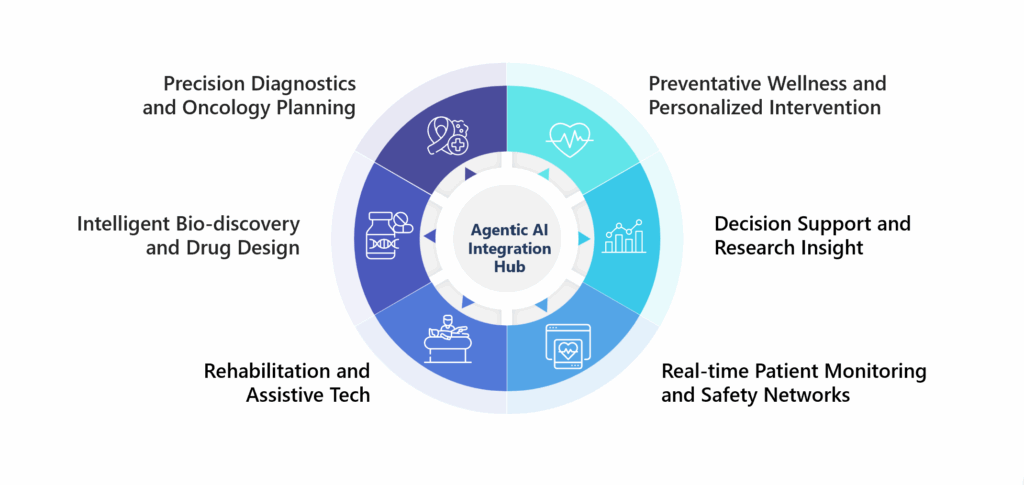
Most digital tools record, alert, and report after the fact. Agentic systems operate within the workflow, capturing context as a case develops and adjusting in real time.
Triage assistants analyze symptoms and route patients before a clinician is involved. AI scribes summarize complex histories, cut documentation time, and surface details that might otherwise stay buried. Operational agents adjust staffing and operating room schedules based on real-time demand, not last week’s forecast. They are beginning to coordinate across organizations by aligning care plans with referrals still in transit.
The same shift is reaching less visible areas. Medication management agents can flag drug interactions before prescriptions are filled. In behavioral health, some systems identify crisis patterns early enough for care teams to intervene. Patient-facing tools, from adherence apps to digital health coaches, can offer daily nudges that a quarterly visit cannot. Unlike rules-based automation, these agents adapt to the person and the situation. That makes them not just faster, but fundamentally different.
What’s shifting is the organizational readiness to act on this
A September 2024 Deloitte survey of 100 US healthcare technology executives found that 40 percent no longer see technical talent as the primary barrier. Resistance to change has eased for 38 percent. The internal conditions that stalled earlier AI cycles are weakening, and the market is moving accordingly. Fortune Business Insights valued the global agentic AI in healthcare market at $1.45 billion in 2025 and projected it would reach $19.71 billion by 2034, at a 34.6 percent CAGR.
The impact runs across the full operating model, but two areas show the clearest before-and-after. In care delivery, pulling together a complete patient picture before a consult used to mean manually collating data across systems that weren’t designed to share it. An agentic system surfaces the relevant history, flags what’s missing, and speeds up the diagnostic conversation without the clinician having to chase it.
AMA data shows that physicians reported a 59-hour workweek in 2023, with 14.1 hours going to indirect patient care and another 7.9 hours to administrative tasks alone. More than one in five physicians spent over eight hours a week on the EHR outside normal work hours, and that number is climbing, not shrinking. That time did not go to patients. It did not go to rest either.
In revenue cycle and claims, the problem has always been upstream: eligibility gaps and coding issues that weren’t caught before the claim went out. Agentic AI catches those issues before submission rather than after rejection. Days in accounts receivable shrink. And when the error rate drops, the payer relationship tends to follow.
A Pattern We’d Seen Before
We recently worked with a leading biotechnology company to deploy an Enterprise-Wide Agentic AI Helpdesk on Microsoft Copilot across six business functions, cutting wait times, saving significant hours monthly, and deflecting routine IT Ticket requests for their Employees.
WinWire built an enterprise-wide agentic helpdesk on Copilot Studio and Azure OpenAI, running inside Teams. No new portal or login. The agent answers questions from governed knowledge sources, routes approvals, and provisions licenses without human intervention. Azure Functions and Power Automate execute the actions; Microsoft Graph connects the agent to enterprise systems.
We began with a prioritization question: which problem should be solved first? During the Imagine phase of our 3i Framework, PRISM, our scoring mechanism, evaluated IT self-service against other AI opportunities and identified it as the highest-return entry point. The remaining 3i phases took it to production.
A Practical Path Forward for Healthcare and Life Sciences Leaders
Healthcare leaders do not need another isolated AI pilot. They need a deployment model that can operate inside real workflows, with the governance, integration, and trust required from day one.
That model has a defined shape. It starts with one high-value scenario, proves value before scaling, and treats integration and governance as part of the build rather than the paperwork around it.
We codified it in our Agentic AI @ Scale approach, anchored in the 3i Framework: imagine the right scenario, validate it with PRISM, ignite it with a proof of value, then accelerate to production.
WinWire, (Part of NTT DATA), works with healthcare and life sciences organizations to design and deploy agentic AI systems that are ready for actual use, built with responsible controls, and aligned to Microsoft technologies.
Ready to see where agentic AI fits in your organization? Let’s set up a Healthcare AI Readiness Session or a PoV Session with the WinWire team.