AI Agent Governance: How Microsoft Agent 365 Closes the Gap

Ashok
AI agent governance is becoming the defining challenge of enterprise AI adoption, and Microsoft Agent 365 is emerging as the platform built to address it. Enterprises are deploying agents faster than they can govern them. Standing up a new agent takes an afternoon. Accounting for one takes something most organizations don’t have: a single place that names every agent running, who owns it, and what data it can reach. That distance, between how fast agents arrive and how slowly anyone accounts for them, is the Governance Gap. Closing it is what now separates a Frontier Firm from a company exposed by its own tools.
The gap is easy to miss because each agent looks reasonable on its own. A sales rep spins one up in Copilot Studio to follow leads. An RPA bot deployed three years ago has quietly matured into something that makes real decisions today. Finance wired two more into the ERP and told no one. Every step made sense to the person who took it.
None of it shows up in one place. No single view names every agent, its owner, and the data it can reach. That blind spot is the exposure leaders have to see before they can manage it.
The numbers show your AI workforce is already here
IDC projects 1.3 billion autonomous AI agents will be operating by 2028. These are not tools people open and close. They are software identities that operate independently at machine speed within enterprise systems.
This is no longer a pilot discussion. It is an operating decision. In Microsoft’s 2025 Work Trend Index, 81% of leaders plan to scale agent use over the next 12 to 18 months, yet IBM found that fewer than four in ten organizations have an AI governance policy. Nutanix’s 2026 Enterprise Cloud Index makes the risk clearer: 79% of IT leaders have already encountered AI applications and agents deployed by employees outside IT’s oversight.
The agents are here, and the ambition is real, but the guardrails are not keeping up.
Gartner sees where that leads. The firm projects that more than 40% of agentic AI projects could be scrapped by 2027, undone by unclear cost, weak controls, and value nobody could prove. Not because the agents failed at the task. Because no one could run them responsibly.
What agents really change
For twenty years, IT ran on a simple map. Applications, the devices they ran on, the people logging in. Agents change the equation. An agent is a first-class identity in your environment, with credentials, permissions, and access to sensitive data, but it isn’t a user you provision once and forget. It acts autonomously, at machine speed, around the clock. This is the new identity perimeter, and most organizations are securing only half of it.
Microsoft calls the organizations that get this right Frontier Firms, companies built around human-agent teams, where every employee takes on a new role: agent boss. And the payoff is measurable. At Frontier Firms, 71% of employees say their company is thriving, compared with just 37% everywhere else.
But you don’t become a Frontier Firm by adding more agents. You become one by learning to lead them. That shift starts with questions most boards are only beginning to ask:
- Who owns this agent?
- What systems can it reach?
- Where is its data going?
- If it makes the wrong call overnight, who’s the first to know.
Today, most enterprises can’t answer cleanly. The best leaders already know it. That honesty is where the real work begins.
AI Agent Governance – Where Microsoft Agent 365 fits
The work begins with something that can actually answer those questions. Until now, no single tool could show you every agent, its owner, and the data it touches. Agent 365 is Microsoft’s move to close that gap.
Announced at Ignite 2025 and generally available since May 2026, Agent 365 is Microsoft’s governance, identity, and security layer for AI agents, available standalone at $15 per user per month. The plainer word for it is a control plane. One place to see and govern every agent you’re running, whether it came out of Copilot Studio, Azure AI Foundry, an open-source framework, or some third-party tool a team picked up last quarter without telling anyone. The move is simple. Take the infrastructure you already trust to manage your people, and point it at your agents.
That means you manage and secure agents with the same rigor you apply to employees and systems.
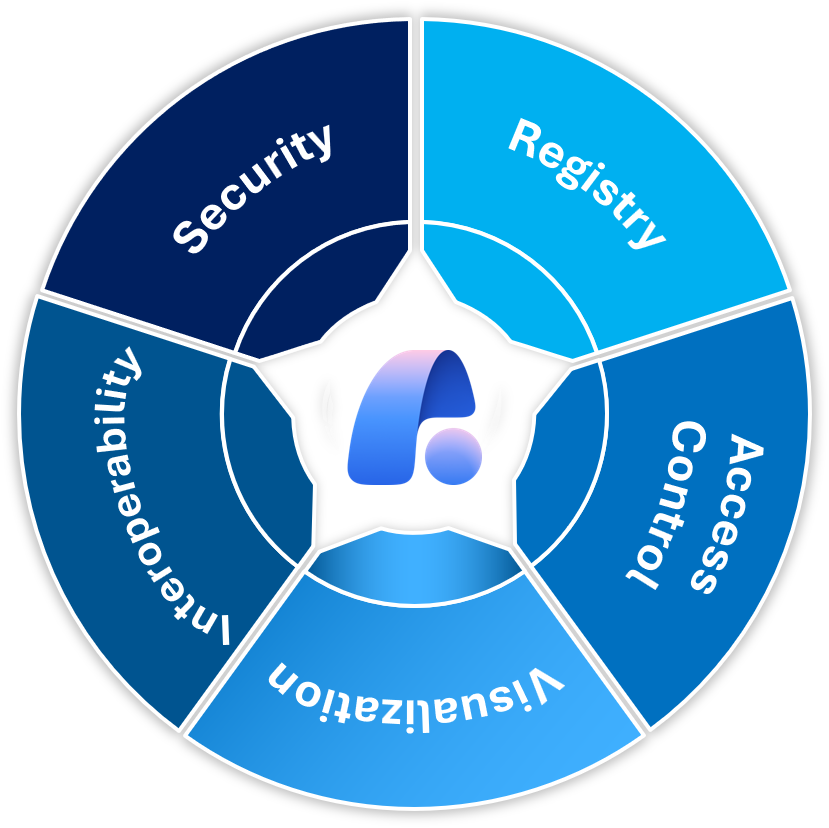
Five Core Capabilities of Microsoft Agent 365 And Why They Matter
- Registry. One source of truth for every agent in your organization, including the shadow agents you didn’t know you had.
- Access Control. Bring agents under management and govern each agent’s access to only the resources and data it needs.
- Visualization. Observe agent behavior in real time and map the connections between agents, people, and data.
- Interoperability. Let agents work across your Microsoft 365 estate and beyond, without leaving governance behind.
- Security. Secure agent identities and protect them from compromise with the Defender, Entra, and Purview controls you already run.
In plain terms, Agent 365 helps turn scattered, anonymous bots into a workforce you can see, secure, and hold accountable. It is not the whole answer, but it gives you the foundation.
What Microsoft Agent 365 Does as the Control Plane
This is the part most rollout decks leave out: a control plane gives you the instrument panel, but it does not fly the plane.
Buying Agent 365 will not decide which agents to trust, how to onboard them safely, when to retire those wasting budget, or how to stay compliant as EU AI Act enforcement begins in August 2026. Those are weekly operating choices made by people who understand both the technology and the business. Governance is not software you install. It is a discipline you run, and most teams are already strained before they are asked to manage a fleet of digital workers.
That is where our point of view moves beyond the standard pitch.
How WinWire AgenticOps Complements Agent 365’s Operating Model
Agent 365 is what finally makes that possible. One place to see, secure, and govern every agent the way you already manage your people. The platform does the heavy lifting. The value shows up once it is running in your environment, tuned to your data, and operated with the same rigor you apply to any production system. That is where WinWire comes in. Our AgenticOps approach, built around the 3i Framework, is how we help you realize full value from Agent 365, and it meets you wherever you are today.
- Imagine. We start by making the invisible visible. In two to three weeks, we inventory every agent across Copilot Studio, custom GPTs, RPA, scripts, and third-party platforms, assess your governance maturity, and deliver a prioritized roadmap to your CIO, CISO, or CAIO. No twelve-month commitment. Just a clear picture of what you are already running.
- Ignite. Then we stand up the governed foundation. Agent 365 configured, Entra Agent IDs deployed, Purview and Defender extended to agents, policies live, and a cost dashboard your CFO will actually read, six to eight weeks to a control plane that holds.
- Impact. After that, we run it alongside you. We keep watch for unusual behavior, respond when something looks wrong, tune costs at the agent level, and ensure every new agent comes in through the same governed path. Each quarter, we sit down with your leadership team to review what is working, what needs to change, and where the portfolio should go next.
At WinWire, our POV holds two things at once. Be Microsoft-first, because that is where your identity, security, data, and productivity stack already lives, and governing agents there means extending what you trust rather than standing up something new. Stay business-first, because governance that cannot show a clear link to lower risk, faster delivery, or business results will not survive the next budget cycle.
Getting Started
That gap, between owning the control plane and operating it well, is where WinWire works. We’ve spent the last few years running agents in production for healthcare and life sciences clients, where a wrong answer carries clinical or compliance cost.
What we learned is pretty mundane. An agent fleet behaves like any other production system. It needs an owner, a budget line, guardrails someone can actually audit, and a record of what each agent did and why. We call that operating discipline AgenticOps. Agent 365 gives you the control plane. AgenticOps is how you operate it, week after week.
That is the work worth starting now.
Talk to us while the fleet is still small enough to get your arms around.
FAQ’S
-
1. What is AI agent governance?
AI agent governance is the practice of discovering, managing, securing, and monitoring AI agents across an enterprise. It ensures every agent has a known owner, appropriate permissions, visibility into its actions, and compliance with organizational policies. As AI agents become autonomous digital workers, governance is becoming as essential as identity and endpoint management.
-
2. What is Microsoft Agent 365?
Microsoft Agent 365 is Microsoft’s control plane for AI agents. It provides a centralized way to discover, govern, secure, and monitor agents built with Copilot Studio, Azure AI Foundry, open-source frameworks, and third-party platforms. It helps organizations manage their growing AI workforce from a single place.
-
3. What is the difference between Microsoft Agent 365 and AgenticOps?
Microsoft Agent 365 provides the platform to discover, secure, and govern AI agents. AgenticOps is the operating model that defines how organizations onboard, monitor, optimize, govern, and retire AI agents throughout their lifecycle. Simply put, Agent 365 is the control plane; AgenticOps is the operating discipline.
-
4. Why isn’t AI agent governance software enough on its own?
Technology provides visibility and security controls, but effective governance also requires ownership, policies, lifecycle management, and continuous oversight. Organizations still need processes to approve new agents, monitor costs and risks, enforce compliance, and measure business value over time.
-
5. How can organizations prepare for enterprise-scale AI agent adoption?
Start governance before AI agent sprawl becomes a problem. Begin by inventorying existing agents, identifying owners, classifying data access, implementing a centralized control plane such as Microsoft Agent 365, and establishing an operating model like AgenticOps to continuously govern security, compliance, costs, and business outcomes.