Agentic AI SuperApp – The Future of Enterprise Workflow Orchestration

Casey
Why Productivity Gains Aren’t Translating into Faster Workflows
A perspective for enterprise technology leaders – How WinWire’s Agentic AI SuperApp closes the orchestration gap that enterprise AI has been missing
The meeting that keeps happening
Somewhere in your organization right now, a new hire is on day three without system access. The laptop request went to IT. Access provisioning went to a different queue. Nothing connected them. The manager is following up manually; the new hire is waiting, and what should have taken a day now takes a week. The systems just never talked to each other.
This is what stalled enterprise AI actually looks like. MuleSoft’s 2025 Connectivity Benchmark Report found that 95% of IT leaders cite integration as the single biggest barrier to AI implementation, and 83% say it’s actively slowing them down. McKinsey’s State of AI 2025 tells the same story from the other end: 88% of organizations use AI in at least one function, but only 39% report enterprise-wide impact. BCG’s AI adoption research puts the consequence plainly: 60% of companies are seeing hardly any material value from their AI investments.
The truth is that the tools got deployed inside systems. Nobody wired them across systems. The gains came, plateaued, and stayed there.
Where the drag actually comes from
The clearest place to see it is in requests that touch more than one system. An employee needs something that involves HR, IT, and Finance before it closes. Each of those functions has a tool. None of the tools connect with each other, so someone has to manually carry context from one stage to the next. If that person is busy, or on leave, or just assumes someone else is handling it, the request sits.
Onboarding is the most visible version of this problem. You can have a perfectly functional ticketing system and still watch a new hire spend their first two days waiting, because the laptop request didn’t automatically trigger the access request. Two separate systems, two separate queues, no connection between them. The tools did exactly what they were built to do. Nobody built the part where they could talk to each other.
What Copilots were built for, and what they weren’t
It’s worth being precise about this, because a lot of the frustration in the market right now comes from expecting copilots to do something they were never designed to do.
A copilot that works well inside Microsoft 365 can improve individual productivity quickly. It may also pull in knowledge, ticket, or service information from connected systems like ServiceNow. But that still is not the same as end-to-end orchestration. It still does not automatically carry shared context across systems, decide what needs to happen next, and move work forward across functions without manual intervention. That is not a failure. It is a scope limit. These tools were built to make individual work faster inside a given environment, and most of them do that well enough.
The limit is structural, and most CXOs are running into it now, even if the internal narrative is still catching up. The cycle-time reductions are real, but they’re flattening. Getting past that plateau means building something different, and it is not smarter individual tools, but a layer that connects them. One that interprets what needs to happen across systems, moves work forward without waiting for a human to manually manage each transition, and actually executes rather than just surfacing information.
Where most enterprise stacks are today
Most large organizations are operating somewhere between Phase 1 and Phase 2 in the table below. A few are at the edge of Phase 3, usually because someone made a deliberate architectural call to get there — not because they stumbled into it.
| Phase | Model | What it does | Limit |
| Phase 1 | Automation | Rules-based systems handle predictable, repetitive tasks reliably | Breaks on anything it wasn’t programmed for |
| Phase 2 | Assistance | AI accelerates individual work: writing, research, summarization, and analysis. | Confined to single-system environments. No cross-system coordination |
| Phase 3 | Orchestration | AI connects systems, departments, and people. Work moves end-to-end without human handoffs. | Most enterprises haven’t built this layer yet. |
Most enterprise AI investment is parked at Phase 2. The gap between Phase 2 and Phase 3 isn’t really about technology. It’s about whether someone in the organization has decided to build the connective layer and given it a home on the roadmap. That decision is harder than it sounds because the problem it solves doesn’t appear cleanly in any single system’s reporting.
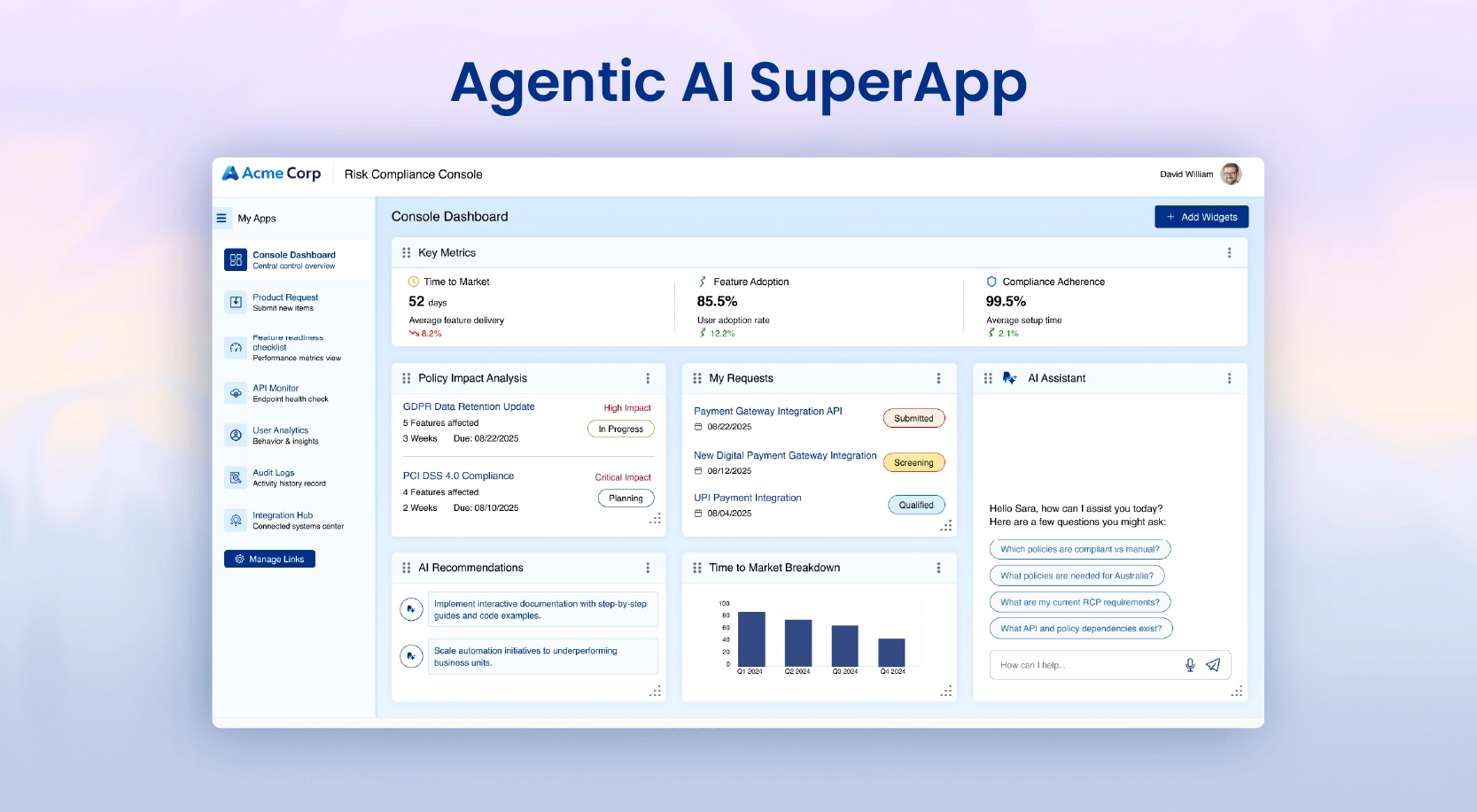
Agentic AI SuperApp
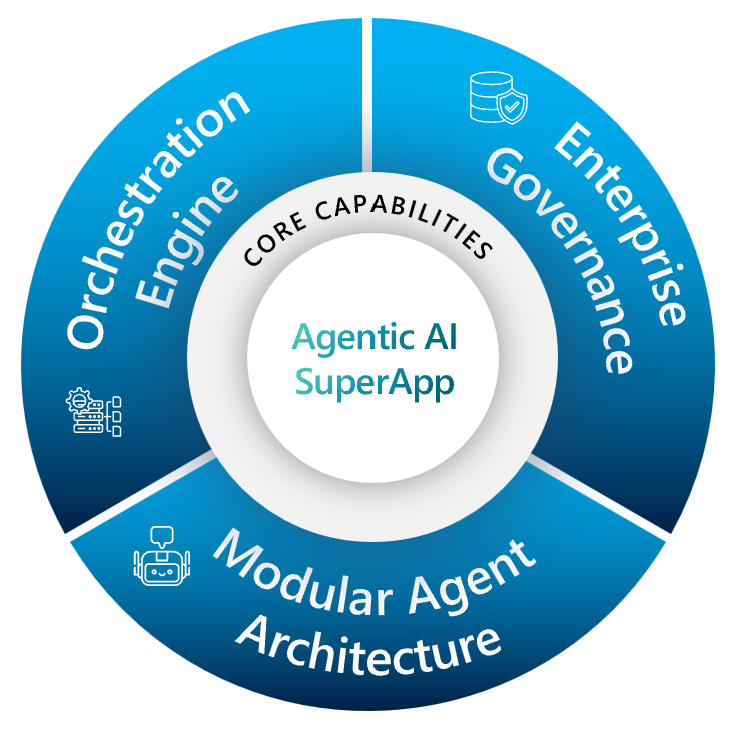
Agentic AI SuperApp unifies business functions such as HR, IT, Sales, Finance & shared services into a single intelligent interface – eliminating the friction of disconnected systems and fragmented processes.
Agentic AI SuperApp complements Microsoft 365 Copilot by orchestrating workflows across enterprise platforms, enabling AI agents to coordinate actions across platforms rather than simply assisting within them.
Built on WinWire’s Agentic AI @ Scale 3i Framework – Imagine. Ignite. Impact. Agentic AI SuperApp enables organizations to operationalize AI with measurable outcomes: faster request resolution, reduced operational costs & workforce productivity at scale.
A global FinTech company had been running a virtual assistant for employees for 2 years across 50+ countries and 25,000 employees. By every internal metric, it was working. Satisfaction scores were solid, retrieval was faster, and nobody was pushing to replace it.
But HR and IT workflows were still fragmented. An employee trying to do anything that crossed a system boundary- Confluence, ServiceNow, Workday, Salesforce, SharePoint, still had to navigate each platform manually and carry context themselves. The assistant could locate an answer, but it could not act on it, pass it along, or follow through.
WinWire brought in Agentic AI SuperApp as the orchestration layer across those systems. Agentic AI SuperApp is not a replacement for the tools already in place. It sits above them — connecting Workday, ServiceNow, Salesforce, SharePoint, and Confluence into a single interface that understands context, routes requests to the right system, and follows through without a human having to carry it from one step to the next.
The same employee who used to bounce between five platforms could now make a request conversationally — HR, IT, leave, document retrieval — through a single interface that held context across the whole interaction and didn’t drop the thread when it crossed a system boundary. What made it stick was that SuperApp didn’t force a single workflow on everyone. An HR business partner and a field sales lead were hitting the same interface, but what happened behind it was completely different — different systems, different routing, different logic. The orchestration shaped itself around the role, not the other way around.
Manual coordination came down. Self-service adoption went up. The Copilot and Azure AI investments that had been producing results in isolation started producing results together, because there was finally something connecting them.
Most of the people involved couldn’t point to a single new tool that got added. The tools were the same. What changed was that the space between them stopped being someone’s job to manage manually.
The question worth asking before the next planning cycle
Most enterprises already have the platforms, the data, and the people. What’s missing isn’t capability — it’s connectivity. The layer that lets all of it operate as a single system rather than several well-configured ones.
And when that layer doesn’t exist, the cost is quiet. Four days in “in review”, not because the work is hard, but because nobody owns the next step. Someone is chasing an approval across two systems. A new hire on day three is still figuring out who to ask, because whoever was supposed to move it along just didn’t. It adds up in ways that don’t show up on any single dashboard.
Start with where the work is getting stuck
WinWire works with organizations to identify where workflow drag is coming from and what it will take to fix it. SuperApp is WinWire’s answer to the orchestration gap. This single intelligent interface connects HR, IT, Finance, Sales, and shared services, and moves work across all of them without anyone having to pick it up manually in between.
A working session with WinWire’s Agentic AI team can surface which workflows are ready for orchestration, what governance needs to be in place before go-live, and how to measure success through cycle time, completion rates, and real business impact — not just hours saved.
Connect with WinWire’s Agentic AI team to see how Agentic AI SuperApp can help you move from isolated pilots to real, enterprise-wide impact.