From UX to AI UX: Redefining the Design Process for Intelligence

Thomas

The rise of AI does not replace traditional UX – it can bring out its boundaries. For many years, UX processes have been optimized for deterministic systems: understanding end users, scenarios, journey mapping, interfaces, usability and iteration. So far this approach has worked well, but one catch is that it only works when systems behave predictably. With AI, the design environment changes, the foundation shifts, and designers have to think differently.
When user intent takes precedence over task flow, and when applications begin to interfere with intent, generate outputs, and make probabilistic decisions, experience design must expand beyond usability to encompass behavior, trust, and decision-making.
It is not about whether traditional UX is relevant or not relevant, it is about how it must evolve. In fact traditional UX still necessary but its incomplete. However, traditional UX continues to provide essential UX structure such as:
- User research grounds us in real needs
- Journey mapping structures experiences
- Information architecture organizes complexity
- Interaction design shapes usability
- Usability testing validates effectiveness
However, traditional methods assume stable system behavior, predictable flows, and that the same action will always produce the same result. But AI breaks these assumptions. Outputs vary, paths are dynamic and decisions are partially automated. This introduces a gap that traditional UX alone cannot address.
The traditional UX process remains important, but it is no longer enough on its own. AI isn’t replacing UX. It’s expanding it. Along with designing interfaces and user journeys, we now need to design experiences for AI behavior, trust, control, and decision-making. When we integrate traditional UX methods with the AI UX process, we can structure it using four connected layers.
UX to AI UX Process
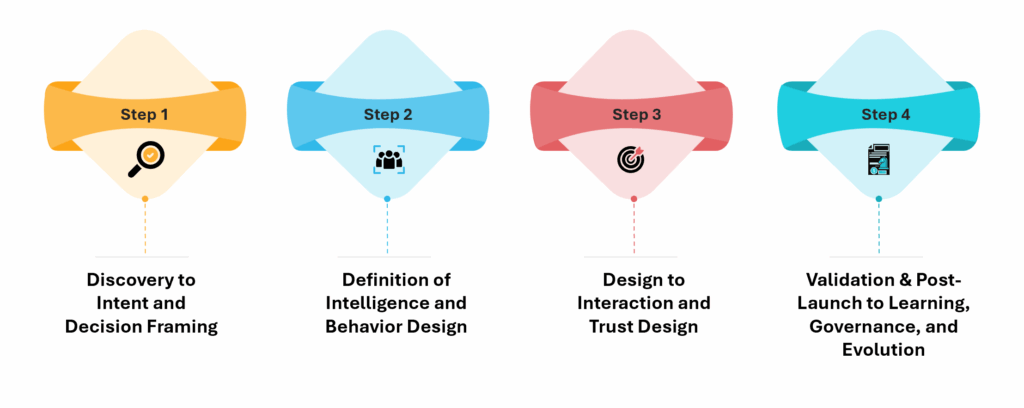
- Discovery to Intent and Decision Framing: The traditional UX asks are who are the users, what their goals are, but AI UX extends this to ask: What decisions are users making? Where does uncertainty exist? Where can AI meaningfully assist or augment judgment? This marks a shift from user journeys to decision journeys. Output of this stage would be: clear identification of where AI should and should not be used; defined success metrics, including decision quality rather than just task completion; and early definition of risks, edge cases, and guardrails.
- Definition of Intelligence and Behavior Design: Traditional UX defines: Flows, features, and system interactions. AI UX adds: System behavior and decision logic. Key questions include: What should the system do in different scenarios? What level of confidence is required before acting? When should the system recommend, act, or escalate? How should failure be handled? This stage introduces a critical shift: Designers are no longer only designing interfaces – they are designing behavior. Artifacts evolve from user flows to decision flows, wireframes to behavior scenarios, and states to probabilistic outcomes
- Design to Interaction and Trust Design: Traditional UX focuses on clarity and usability. AI UX must additionally design trust and collaboration. This includes how AI decisions are explained, how confidence is communicated, how users can edit, override, or reject outputs, and how control is balanced with automation. The goal is not just ease of use, but calibrated trust. Design must prevent:
Blind trust (over-reliance), Complete distrust (rejection of AI). This layer ensures users understand: What the system is doing, why it is doing it, and how much they should rely on it.
- Validation & Post-Launch to Learning, Governance, and Evolution: Traditional UX validation focuses on: Task success, Efficiency and Error rates. However, AI UX must also evaluate: Trust and reliance patterns, Decision accuracy over time, Failure modes and edge cases, Bias and fairness, and User override behavior. Importantly, this stage does not end at launch. AI systems evolve, and so must the experience. This introduces ongoing responsibilities: Monitoring real-world usage, updating guardrails and governance and feeding insights back into models and design.
Traditional UX provides the structural foundation. AI UX adds a behavioral and decision-making layer across every stage.
In practice:
- Discovery includes both user research and decision mapping
- Definition includes both feature design and behavior logic
- Design includes both interface creation and trust mechanisms
- Validation includes both usability testing and system performance monitoring
Rather than adding a separate “AI phase,” intelligence becomes embedded throughout the entire design lifecycle. AI influences how we understand user needs, design experiences, validate solutions, and measure success.
The most significant shift, however, is that we are no longer designing only interfaces. We are designing decision-making experiences. UX is no longer just about helping users complete tasks efficiently; it is about helping them make informed decisions, work effectively alongside AI, navigate uncertainty, and remain confident and in control even when automation is involved.
This fundamentally changes the role of design. Designers must now think beyond screens and workflows. They need to shape how AI makes recommendations, how those recommendations are explained, how users can question or override them, and how the system responds when things go wrong. In essence, UX is evolving from designing interactions to designing trustworthy relationships between humans and intelligent systems.
What does this means for organizations? Teams do not need to discard their UX processes. They need to extend them. This requires:
- New artifacts such as decision maps and AI behavior scenarios
- Cross-functional collaboration with data science and engineering
- Inclusion of ethics, governance, and risk in design discussions
- Continuous monitoring beyond product launch
The organizations that adapt fastest will be those that treat AI not just as a capability, but as an experience that must be intentionally designed. Because in the AI era, success is not defined by how intelligent the system is, but by how well humans can understand, trust, and work with that intelligence.