Microsoft 365 E7 Explained: What It Bundles, and Why Licensing Alone Won’t Close the AI Value Gap

Ashok
What is the gap between AI adoption and AI value?
McKinsey’s 2025 State of AI survey found a clear gap between adopting AI and generating measurable business value from it. While 88 percent of respondents said their organizations use AI in at least one business function, only about 6 percent qualified as high performers. McKinsey defines these organizations as those that attribute at least 5 percent of EBIT to AI use and report substantial business value from it. The survey covered 1,993 respondents across 105 countries, making the gap difficult to dismiss as a narrow-market finding.
The difference is not adoption alone. McKinsey found that high performers are more likely to redesign workflows, establish clear leadership ownership, define when human validation is required, and build the operating practices needed to scale AI. Most organizations have introduced AI somewhere. Far fewer have changed how work is carried out around it.
This distinction becomes even more important with agents. A successful demonstration shows that an agent can complete a task. Production use requires the organization to answer harder questions: Who owns it? What data can it access? Which actions can it take? And can those actions be reconstructed and reviewed later?
Closing the gap, therefore, depends on more than just adding new capabilities. It requires agents to operate within the organization’s identity, security, data, and governance environment, with clear access controls and an auditable record of their actions.
What do the top AI performers do differently?
Their operating models settle who owns an agent, what it can reach, and who signs off on it before it ships, rather than after. Microsoft’s Frontier Firms concept describes a related operating model: a human-led, agent-operated organization where people and agents work through redesigned workflows. The label matters less than the discipline behind it. Agents can’t act anonymously, access can’t stay informal, and important actions have to be recorded.
That foundation rarely exists in a ready-made form. It has to be assembled from the identity, security, and data tooling the organization already runs. Those systems may exist independently, but they often have not been connected in a way that enables agents to perform work safely.
This is also where many businesses underestimate the effort involved. Buying the platform provides the components. Turning them into a governed environment that supports production use requires integration, workflow redesign, and ongoing management.
What is Microsoft 365 E7 and what does it include?
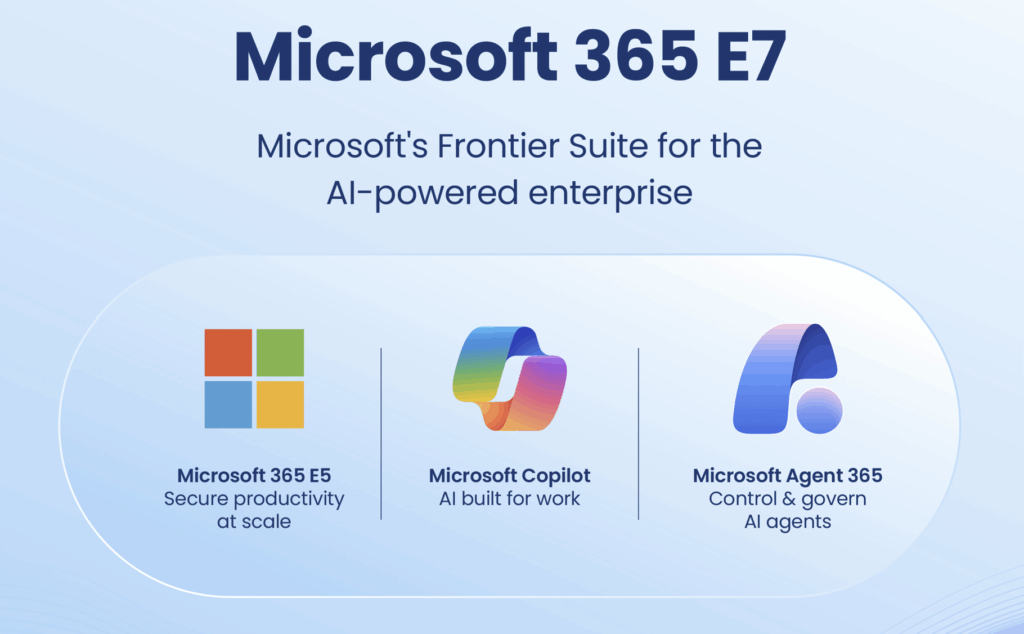
Microsoft 365 E7 became generally available on May 1, 2026. It combines Microsoft 365 E5, Microsoft 365 Copilot, Agent 365, and the Microsoft Entra Suite in a single package powered by Work IQ. What makes Microsoft 365 E7 strategically interesting isn’t simply that these capabilities are bundled together. Copilot changes how people work. Agent 365 extends governance to the emerging AI workforce. Entra strengthens the identity and access layer. Work IQ provides the organizational context that makes AI more useful. The opportunity comes from making these capabilities work together—not deploying each independently.
Is a technology suite enough to close the AI governance gap?
That doesn’t change the figures from the top of this article. Most organizations have adopted the technology. Very few are capturing real value, and the issue is governance. By McKinsey’s own count, only about one-fifth of adopters have fully redesigned a workflow around AI, which is the move most closely tied to EBIT impact. Gartner predicts that more than 40% of agentic AI projects will be canceled by 2027 due to cost, unclear value, or a lack of controls. A license simplifies procurement and provides the platform. It does not redesign workflows or establish the operating model around it.
That part usually gets left out of the sales pitch. A licensed platform still has to become AI capabilities people actually use and can govern, without anyone losing sight of what’s running where. The suite provides the technology layers, but the operating model determines how Copilot, Agent 365, Entra, and Work IQ work together in practice.
How do you move from an E7 license to a working operating model?
Closing that gap is where implementation matters more than the license. Our Agentic AI at Scale approach, built around the 3i Framework, addresses three questions that Microsoft 365 E7 buyers must answer: where the upgrade is justified, how the platform will be deployed, and how value will be sustained after launch.
The three phases below answer those questions in turn.
Imagine – Is the upgrade justified?
Before anything gets built, we settle whether Microsoft 365 E7 is worth it for this customer, and we base that on real usage, not list price. The assessment typically takes two to three weeks.
- Microsoft 365 E7 readiness and licensing assessment, mapping current E5 consumption against what Microsoft 365 E7 adds.
- Full agent inventory across the tenant, with a Copilot and security posture review.
- A PRISM-scored use-case backlog and a business case that holds up in front of the CFO.
Ignite – How does it get deployed?
This is where the platform starts to earn its cost. The deployment has to bring together Copilot adoption, Agent 365 governance, Entra identity controls, and the organizational context provided by Work IQ. And because building agents drives new Azure consumption, some eligible engagements may also qualify for Microsoft investment programs, which can improve the implementation cost case and change the customer’s math.
- Establish an Agent 365 governance model, including the agent registry, policies, ownership, and identity controls.
- Configure the Entra Suite around the organization’s Zero Trust policies.
- Roll out Copilot with real adoption support and change management.
- Build governed agents on AgentVerse and its 30-plus pre-built agents.
Impact – How is value sustained?
This is where implementation becomes an ongoing operating discipline. Governance here isn’t a one-time gate. It’s what lets the business keep saying yes to the next use case.
- Monitor agents in production, tracking performance, activity, risk, and cost.
- Run a live use-case pipeline that keeps adoption moving past the first quarter.
- Apply FinOps on the consumption layer so token spend stays tied to value.
How do you decide which users actually need Microsoft 365 E7?
A global technology company came to us with roughly 20,000 Copilot licenses and a question many rollout teams skip: which users would gain enough from Microsoft 365 E7 to justify the upgrade?
Moving everyone up would have meant paying for capabilities that many roles would never use. So we ran it as a segmentation exercise instead. We looked at how much value each role would actually pull from Agent 365 and the Entra Suite, then drew the upgrade line where the work earned it.
The client walked into its renewal with a defensible number rather than a blanket one. Any large tenant hits the same question. The real skill is knowing where that line falls before you sign for the whole org.
We treat Microsoft 365 E7 as a starting point, not an endpoint. The license gives you the platform. Turning it into a governed system people trust, at a cost you can defend, is a different job.
The gap between the 88% and the 6% was never about better models. It was about the operating model underneath them. That’s the work Microsoft 365 E7 makes possible and the work it leaves to you.
Is Microsoft 365 E7 worth it for your organization?
If you’re weighing Microsoft 365 E7 against what you already run, WinWire can help by assessing readiness, finding the right users and use cases, and putting governance in place to scale safely. Get in touch with us.